

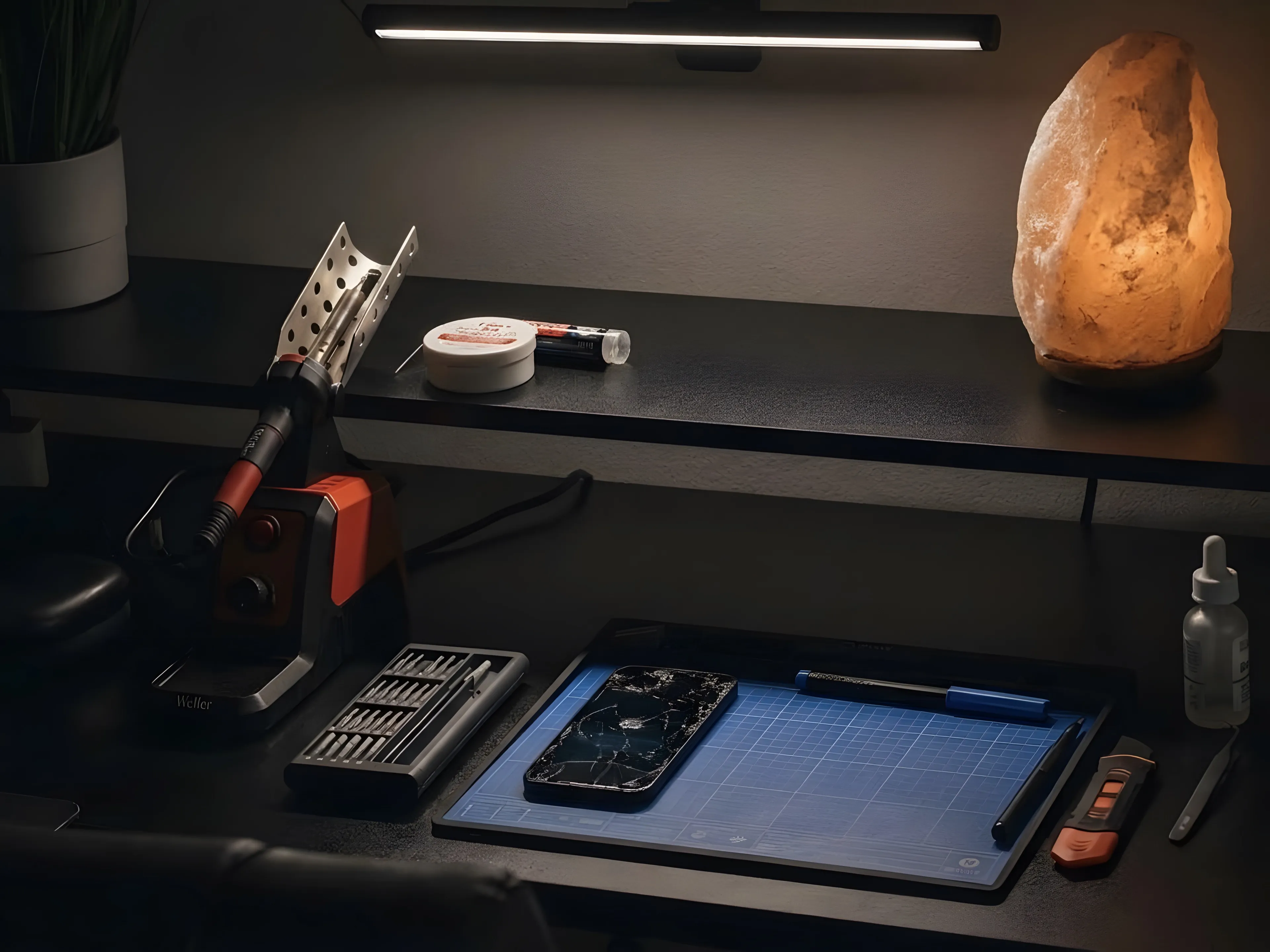
Genuine parts, fitted wherever you are.
Phones, tablets, laptops and consoles, Apple or anything else. Quality parts, fitted properly, at your home, your office, or a public spot you choose. Once I have the part, most repairs take an hour or two. Got turned away somewhere else? Bring it here. I take on the repairs other shops decline.
Tell me the model and what it’s doing. You’ll usually hear back the same day. If it isn’t worth fixing, I’ll say so.
What comes in
Whatever it is, tell me about it. iPhone or Android, Mac or Windows, PlayStation, Xbox or Switch. This is most of what lands on the bench in a given month.

Screens and glass
Cracked glass, dead touch, color bleeding, backlight gone. Genuine parts if you want them, calibrated after fitting, and done an hour or two after the part arrives.
Batteries
Batteries wear out. As they do, your phone slows itself down to protect them, and it still dies sooner.
Dead devices
No power, no display, no response. You may have been told the board is dead. Often it’s the battery, the screen, water damage or a short. I find out which before we talk about cost.
Game consoles
HDMI ports, drifting sticks, fans that sound like a jet, drives that quit reading discs. PlayStation, Xbox and Switch.
Liquid damage
The sooner it gets to me, the more of it survives. Full teardown, ultrasonic clean and corrosion repair before I try anything else.
Windows and macOS
Machines that won’t boot, run painfully slow, throw errors, or need everything moved to a new computer without losing anything.
Networking
Wi-Fi that keeps dropping, dead spots, router and switch setup, small business systems. I’m certified for this one.
Backups and transfers
Moving everything onto a new machine, disk images, restores. I don’t do forensic recovery off a drive that’s already dead. That takes a specialist lab, and I’ll tell you so.

A dead device is rarely a lost cause.
Unless you’re still under AppleCare or a warranty, a new one costs far more than a repair, and a repaired device stays out of the landfill.

I am not the cheapest.
Better you read that here than in the quote. Apple comes up the most below because Apple repairs are the expensive ones, but it works the same way for every device I fix.
The cheapest repair in town
It is the shop fitting a part nobody can tell you the origin of, with no calibration afterwards. The phone works when you pick it up, and then the problems start. You save today and pay for the same repair again within the year.
The manufacturer
Apple, Samsung, Sony. Genuine parts, done properly, and often cheaper than I am. What it costs you instead is time: an appointment, a trip or a mail-in, and a wait. If that trade suits you, take it, and I will tell you so.
What I do
The same quality of part, fitted and calibrated. The difference is that the only wait is for the part to arrive, the repair itself takes an hour or two, there is no appointment to book, and I travel to you at no extra charge. The higher price covers the speed and the travel. Parts are fitted neatly, never slapped on, and your device comes back looking factory clean.
If the budget is tight
Tell me. I can use an OEM pulled part or a high quality aftermarket part instead, and the price comes down a long way. They also arrive faster, so at its quickest you have your device back, like new, within one to two days of asking. I will tell you what you give up before you decide.
How it works
Every request gets a ticket number the second it lands, and you can check where it stands any time without having to email me and ask.
You tell me what happened
The model and what it’s doing now, in your own words. How it broke usually narrows down the fault before I’ve even opened it.
I diagnose it
I open it up and find what went wrong, then explain it in plain English: what needs fixing, what I recommend, and whether the repair is worth it for that device.
You approve a price
One number that covers parts and labor. I won’t start any repair until you say go.
We sort the handover
Drop it off, meet somewhere easy, or I’ll pick it up and bring it back. We figure that out once you’ve okayed the price.

About
It’s just me.
The person who quotes your repair is the person who does it, and the same person who tells you when it isn’t worth the money.
I’ve always been hands-on. Taking something apart to see how it works, then putting it back together better than I found it. I’ve done that since I was a kid, opening up anything I was allowed to touch. At 13 I built a computer with my dad. At 14 I built my own.
That’s still how I work. Every device gets opened up and figured out before anyone talks about money. I’d rather spend an hour finding the real fault than fifteen minutes swapping a part that might not even be the problem, and I’d rather tell you a repair isn’t worth it than take the job anyway.
I do every repair myself, and I don’t start until you say yes.
I write about this stuff too.
When something new comes out I take a look at what changed inside it, what the company oversold, and whether it’s worth your money. No sponsorships, no affiliate links, just my honest read on it.
Tell me what broke.
The model, what it’s doing, and roughly how it happened. That’s enough to start.